The “religious war” between Python and C++ in algorithmic trading usually boils down to a single trade-off: Python is faster for getting ideas to market, while C++ is faster for getting orders into the book.
But why choose? With the advent of C++26 Reflection, you can now have the flexibility of a Python-based strategy without the performance penalty of slow loops.
Bring in C++ Rapidly: How Reflection Works
The biggest hurdle in hybrid trading systems has always been the “bridge.” Traditionally, if you wrote a complex pricer in C++, you had to manually write “boilerplate” code to tell Python how to talk to it. If you added a new function, you had to update the bridge. It was tedious and error-prone.
Reflection changes the game by allowing the code to “look in the mirror”. Instead of you manually describing your C++ functions to Python, the compiler does it for you. It programmatically inspects your classes and generates the bindings automatically.
1. The C++ Logic
Imagine you have a complex pricer, like the Merton Jump Diffusion (MJD) model. This model is essential for crypto because it accounts for sudden “jumps” in price, but it is mathematically heavy. The fair value ($V$) involves a complex summation that would crawl in pure Python:
\[V = \sum_{n=0}^{\infty} \frac{e^{-\lambda' T}(\lambda' T)^n}{n!} BS(S_0, K, T, \sigma_n, r_n)\]In C++, your interface looks like this:
class OnlineMertonCalibrator {
public:
    OnlineMertonCalibrator(MertonParams initial, CalibratorConfig config = {});
    bool update_tick(double price, std::int64_t epoch_us);
    bool maybe_update_params();
    double fair_value(double s0, double q_annual, double t_years, double r = 0.0) const;
};
2. The “Magic” Reflection Loop
Using a specialized fork of Clang (produced by Bloomberg), we can write a generic function that loops through every member of our class. It identifies public functions and automatically creates a Python-friendly version of them. The loop itself is binding-library agnostic — the wrapper type Cls is whatever your binding library hands you (py::class_<T> for pybind11, nb::class_<T> for nanobind):
#include <meta>
using namespace std::meta;

template <typename T, typename Cls>
void bind_reflected_member_functions(Cls& cl) {
  // 1. Get a list of all members of the class at compile-time
  constexpr auto members = std::define_static_array(
    members_of(^^T, access_context::current()));

  // 2. Loop through them and filter for public functions
  template for (constexpr auto m : members) {
    if constexpr (is_public(m) && is_function(m) && !is_constructor(m)) {
      constexpr auto fnName = identifier_of(m);

      // 3. Automatically define the function for Python
      cl.def(fnName.data(), &[:m:]);
    }
  }
}
Note: This process runs during compilation, so there is zero impact on your trading speed.
3. The Result: Native Speed in Python
Once compiled, your high-performance C++ class is available in Python as if it were a native library. You get the microsecond-level precision of C++ with the scripting ease of Python:
import merton_online_calibrator as moc

# Initialize the C++ class directly from Python
c = moc.OnlineMertonCalibrator(params, config)

# Run the heavy math at C++ speeds
v = c.fair_value(mid, funding, years, rate)
Update: Why pybind11 — and what about nanobind?
After this post first went up, I shared the repo on r/cpp. A user asked the obvious question:
If latency is a concern which you mention a few times in the docs, why not use
nanobind?
Fair point. nanobind (by Wenzel Jakob, the original author of pybind11) targets modern C++ and reports roughly 4× faster compile times, 5× smaller binaries, and 10× lower per-call runtime overhead than pybind11. For anything where you cross the C++/Python boundary on the hot path, that matters.
The reason the example above uses pybind11 is purely historical: Callum Piper’s ACCU 2025 talk — which got me started — uses pybind11, and I wanted to keep the post faithful to that.
The good news: because the reflection loop is generic on the wrapper type, switching to nanobind is essentially a one-liner at the call site. The module definition becomes:
#include <nanobind/nanobind.h>
namespace nb = nanobind;

NB_MODULE(merton_online_calibrator, m) {
  nb::class_<merton::OnlineMertonCalibrator> cl(m, "OnlineMertonCalibrator");
  cl.def(nb::init<merton::MertonParams, merton::CalibratorConfig>(),
         "initial"_a, "config"_a = merton::CalibratorConfig{});
  bind_reflected_member_functions<merton::OnlineMertonCalibrator>(cl);
}
The merton-market-maker repo now supports both backends — pick one with the MERTON_PYTHON_BINDING build variable (pybind11 or nanobind), or run just setup-defaults and choose interactively.
Making it a Reality
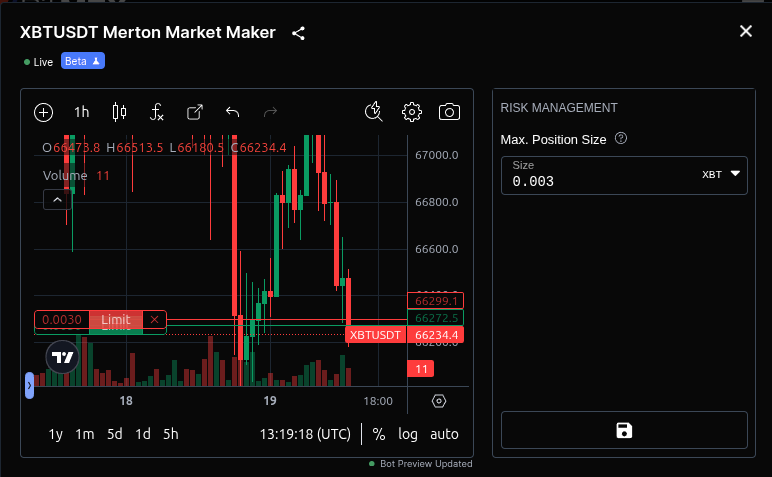
This isn’t just theory. We have deployed a live market-making bot on BitMEX using this exact architecture. By using C++ for the “fast loops” and Python for the strategy logic, we can exploit mispricings in liquid contracts like XBTUSDT. Get in the Beta programme and then try it out here (ask me how at richard@profitview.net).
Getting Started
To experiment with C++26 reflection yourself, you will need a specific environment since the standard is so new:
- Compiler: Use the Bloomberg Clang P2996 fork.
- Environment: We recommend using Docker to manage the complex build dependencies (Clang, QuantLib, and Python bindings).
- Bindings: Choose
pybind11ornanobindviaMERTON_PYTHON_BINDING(or just runjust setup-defaults). - The Code: You can clone our full proof-of-concept from GitHub.
Risk Warning: This strategy is a proof of concept. Only risk funds you can afford to lose.
Thanks to Callum Piper whose excellent short talk from last year’s ACCU conference showed me the Bloomberg fork was successful with reflection and pybind11. And thanks to u/sumwheresumtime on r/cpp for the nudge to add nanobind as a first-class option.
If you need any help getting this working - at home or in your trading environment - feel free to contact me.